
Commercial Reconstruction & Repair After Water Damage
Restoring office, medical, and retail spaces back to pre-loss condition
Water damage in a commercial space is never just about drying things out. It disrupts operations, impacts revenue, and in medical environments, can compromise patient care. The difference between a stressful, drawn-out recovery and a controlled, efficient rebuild often comes down to who is guiding the process.
Many owners are told to use a preferred vendor through their insurance carrier. In one recent case, my client was directed to use Servpro as both the mitigation and reconstruction contractor due to an existing partnership. That is a common recommendation. It is not, however, a requirement.
You have the right to choose your contractor
After a water loss, insurance carriers often suggest vendors they work with regularly. These companies can be effective for emergency mitigation, but reconstruction is a different discipline entirely.
My client, a physician with an active practice, needed more than drying and demo. She needed:
A coordinated rebuild that met medical standards
Clear communication around schedule and cost
Someone to advocate for her during the insurance process
She made the decision to bring in her own contractor, and that’s where we stepped in.
A different approach to reconstruction
Commercial reconstruction requires a balance of technical execution and operational sensitivity. In office, medical, and retail environments, the goal is not just to rebuild, but to restore functionality as quickly and seamlessly as possible.
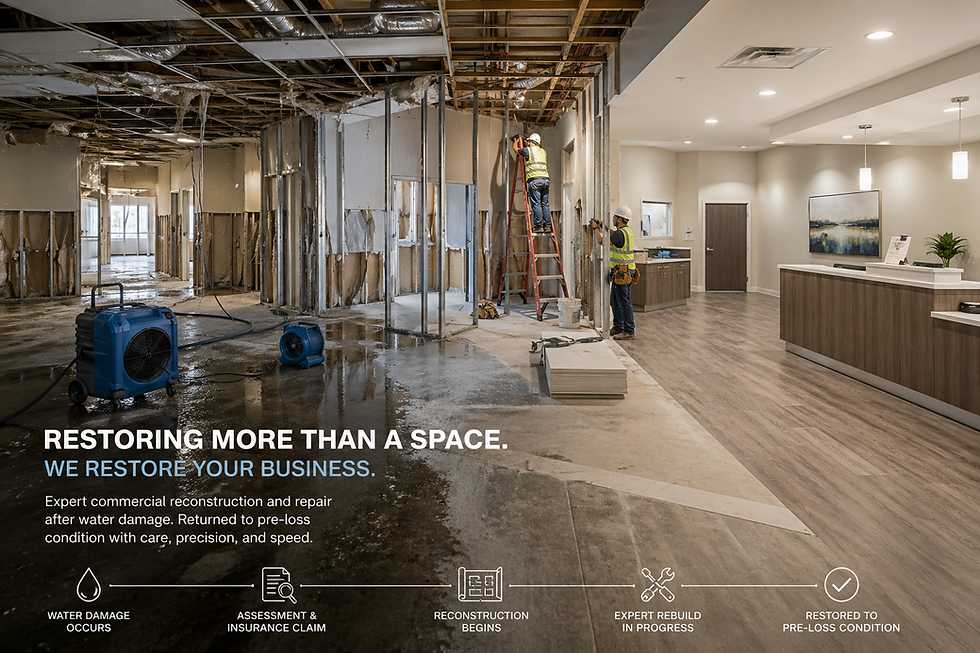
We approached the project in three phases:
1. Stabilization and scope alignment
Working alongside the mitigation team, we ensured all affected areas were properly documented. This included:
Verifying the full extent of water intrusion
Identifying concealed damage behind walls and above ceilings
Aligning the scope of work with what insurance would cover
2. Insurance coordination and documentation
This is where many projects slow down. We worked directly with the client and their insurance adjuster to:
Translate construction scope into insurance language
Provide detailed estimates and supporting documentation
Coordinate approvals to avoid delays between phases
For the client, this meant fewer back-and-forth emails and a clearer path forward. For the project, it meant momentum.
3. Reconstruction to pre-loss condition
Once approved, we focused on rebuilding the space to its original condition while improving durability where possible. This included:
Reconstructing walls, ceilings, and finishes
Coordinating mechanical, electrical, and plumbing trades
Matching existing materials to maintain continuity throughout the space
In medical environments especially, attention to detail matters. Finishes, layouts, and systems all need to align with how the space operates day to day.
Why reconstruction is different from mitigation
Mitigation companies are designed to respond quickly to emergencies. Reconstruction requires a different level of planning, coordination, and accountability.
In commercial settings, the stakes are higher:
Office spaces need to get employees back to work
Retail spaces need to reopen to generate revenue
Medical offices need to maintain compliance and patient trust
That requires a contractor who understands not just how to build, but how to operate within an active business environment. Or in the case of our doctor client, we knew how to operate in an occupied medical clinic.
Acting as an advocate for the client
One of the most valuable roles we play in these situations is acting as a bridge between the client and the insurance process.
We help:
Clarify what is covered and what is not
Ensure the full scope of damage is recognized
Keep the project moving by aligning documentation with construction timelines
For this client, that meant less friction, fewer surprises, and a faster return to normal operations.
The outcome
The space was restored to its pre-damaged condition, with minimal disruption to the client’s long-term operations. More importantly, the client felt supported throughout the process, not managed by it.
Water damage is unpredictable. The recovery process doesn’t have to be.
If you’re navigating a commercial insurance claim for an office, medical, or retail space in the Chicagoland area or beyond, having the right reconstruction partner can make all the difference, not just in how the space is rebuilt, but in how the entire experience is handled.