Choosing Your Contractor After Water Damage: What Medical, Office, and Retail Owners Need to Know
When water damage hits a commercial space, the first call is usually to insurance. The second decision, often made quickly and with limited information, is who will rebuild the space.
In many cases, owners are directed toward a “preferred vendor” through their insurance carrier, such as Service Master. These firms play an important role in emergency response. But reconstruction, especially in medical, office, and retail environments, is a different discipline, and it’s where owners should slow down and understand their options.
Mitigation and reconstruction are not the same
After a loss, there are typically two phases:
Mitigation: drying, demolition, and stabilizing the space
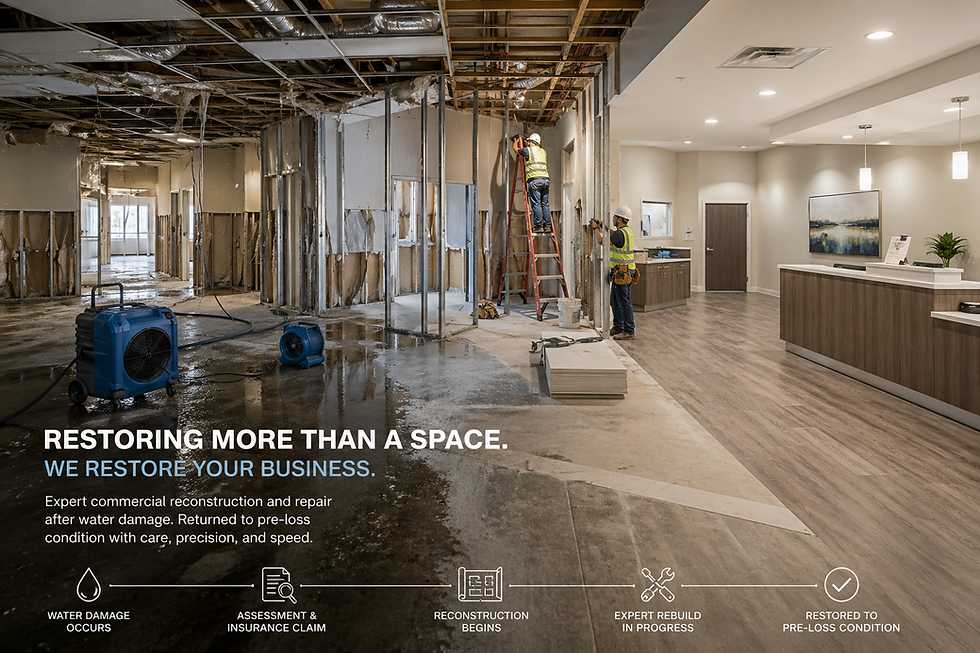
Reconstruction: rebuilding the space to its original, pre-damaged condition
Mitigation companies are designed to respond quickly and prevent further damage. Reconstruction requires planning, coordination of multiple trades, and a deep understanding of how the space needs to function once it reopens.
In a medical office, for example, this can include:
Restoring layouts that support patient flow
Coordinating mechanical and electrical systems tied to equipment
Matching finishes and materials that impact cleanliness and durability
That level of detail often requires a contractor whose primary focus is construction, not just restoration.
The subtle conflict most owners don’t see
Insurance carriers aim to manage claims efficiently and control costs. Preferred vendors are often part of that ecosystem, which can help move things along quickly.
However, this can create a difference in priorities:
The insurance process focuses on resolving the claim efficiently
The owner needs the space fully restored and operational
Those goals overlap, but they are not identical.
An owner-selected contractor is accountable directly to the client, not the carrier. That often results in:
More thorough documentation of damage
A more complete reconstruction scope
Greater attention to how the space performs long-term
Scope matters more than the number on the bid
One of the most common misconceptions in insurance-driven work is that all bids are equal. They’re not.
If one bid comes in lower, it may reflect:
A narrower scope of work
Fewer allowances for hidden or future issues
Standardized assumptions that don’t fully match the space
A higher or mid-range bid often includes:
More comprehensive coverage of the damage
Trade coordination and project management
A focus on restoring the space to how it actually functioned before the loss
In many cases, the difference is not just price. It’s what is being rebuilt and how well it will perform once complete.
Why this matters more in medical, office, and retail spaces
Commercial environments are operational assets, not just physical spaces.
Medical offices depend on compliance, cleanliness, and patient trust
Office environments need to support teams returning to work quickly
Retail spaces rely on speed to reopen and consistency across locations
If reconstruction is incomplete or rushed, the impact goes beyond construction. It affects revenue, operations, and reputation.
The role of an owner defined general contractor
When owners bring in their own commercial general contractor, they hire an advocate aligned with their interests.
A contractor working directly for the owner can:
Coordinate closely with the insurance adjuster to align scope and documentation
Identify and justify damage that might otherwise be overlooked
Manage the project with the owner’s timeline and operations in mind
This doesn’t mean replacing mitigation teams. In many cases, the best outcomes come from collaboration, where mitigation is handled quickly and reconstruction is led by a contractor focused on long-term performance.
Making the right decision for your space
You are not required to use your i preferred vendor for reconstruction. You have the ability to choose a contractor who aligns with your priorities, your timeline, and the way your space needs to function.
The right partner will not only rebuild what was damaged but will help guide you through the process, from documentation to final delivery, so that your business can return to normal with confidence.
Water damage is disruptive, but the recovery process can be managed with the right team in place.
For owners of medical, office, and retail spaces, that often means separating emergency response from reconstruction and ensuring that someone is fully representing your interests throughout the rebuild.